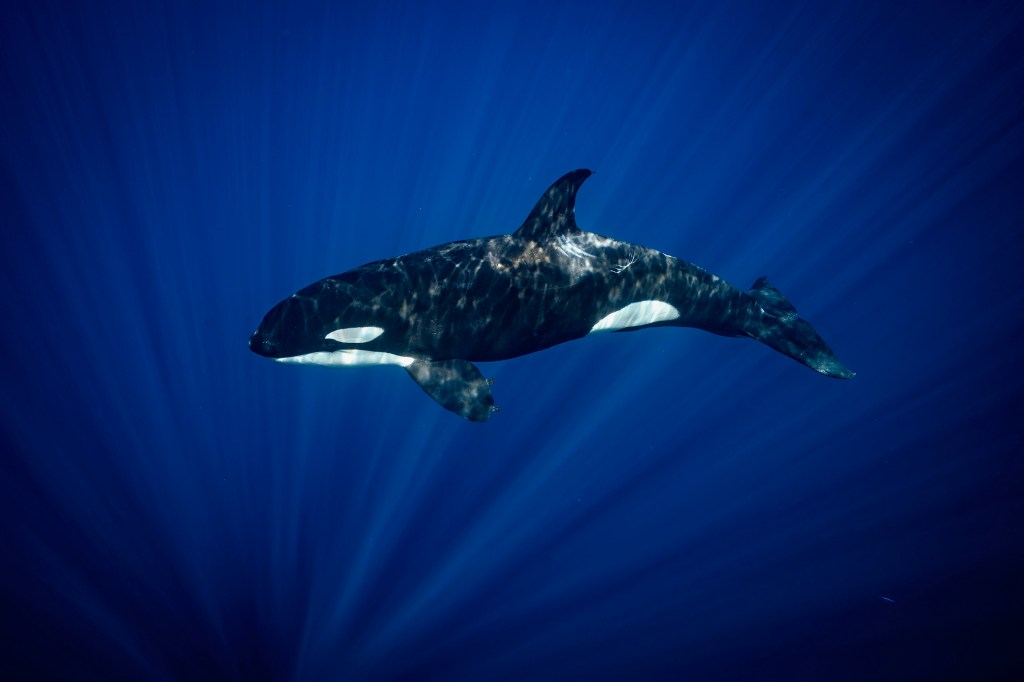
Many people wonder whether it’s legal to swim with orcas in Mexico. The answer is not as straightforward as you might think, due to different regulations and laws concerning marine mammals. In this blog, we will explore the relevant regulations, focusing on Mexican environmental laws, and explain what is currently permitted when it comes to swimming with orcas.
Table of Contents
- August 2025 Update – New Regulation in La Ventana and Esenada de Muertos
- 1. Overview of Mexican Environmental Regulations
- 2. What Does NOM-131-SEMARNAT-2010 Cover?
- 3. Special Protection Under NOM-059-SEMARNAT-2010
- 4. Is Swimming with Orcas Legal?
- 5. Ethical Considerations and Conservation
- Conclusion
- Related Articles
August 2025 Update – New Regulation in La Ventana
Since this article was first published, SEMARNAT has introduced a new Orca Management Plan (Plan de Manejo Tipo) that regulates swimming and whale watching with orcas exclusively in the La Ventana region, including Ensenada de Muertos, in Baja California Sur.
This plan defines a specific maritime area where orca-related activities are allowed under strict conditions — including limits on swimmer numbers, boat proximity, permitted times of day, and behavioral criteria based on the state of the animals.
➡️ If you’re planning to swim with orcas in La Ventana or Ensenada de Muertos, make sure to read our full article for all the rules and restrictions:
👉 New Orca Management Plan in La Ventana and Ensenada de Muertos: Rules, Zones and Guidelines for 2025–2026
While this area now has a formal regulatory framework, it’s important to understand that the rest of Mexico still operates in a legal gray zone — where swimming with orcas may be interpreted as legal, illegal, or simply unregulated, depending on the location and enforcement.
Always approach with caution, respect the animals, and prioritize their well-being above all.
1. Overview of Mexican Environmental Regulations
Mexico has strict regulations regarding the protection of marine life, including whales and other cetaceans. These laws aim to conserve endangered species and regulate human interaction with marine animals. Two of the most important norms in this regard are NOM-131-SEMARNAT-2010 and NOM-059-SEMARNAT-2010.
These regulations primarily focus on the protection and observation of whales and other species. However, they don’t explicitly regulate interactions with all marine mammals, like orcas (Orcinus orca).
2. What Does NOM-131-SEMARNAT-2010 Cover?
NOM-131-SEMARNAT-2010 is a national standard focused on the protection and management of whale-watching activities in Mexico. According to this regulation, swimming, diving, and other direct interactions are prohibited during whale-watching tours, but this applies specifically to baleen whales (Mysticeti) and the sperm whale (Physeter macrocephalus).
This law does not explicitly cover other odontocetes, such as orcas or dolphins. Therefore, this regulation doesn’t prohibit swimming with orcas, as they fall outside the species listed in the NOM-131 standard.
3. Special Protection Under NOM-059-SEMARNAT-2010
NOM-059-SEMARNAT-2010 classifies various species, including orcas, under different risk categories. Orcas are considered species “Subject to Special Protection.” This means that while they aren’t facing imminent extinction, they require protective measures to ensure their long-term conservation.
While this norm provides guidelines for conservation and management, it does not specifically regulate swimming or other direct interactions with orcas. It focuses more on preventing their capture or harm rather than interactions like swimming.
4. Is Swimming with Orcas Legal?
In Mexico, there is no specific federal law that explicitly prohibits swimming with orcas. While orcas are classified as species needing special protection under NOM-059, there is no outright ban on swimming with them. The absence of such regulation means that, legally speaking, it is allowed.
However, local authorities or tour operators may have their own regulations or ethical guidelines that could limit or prohibit these activities on a case-by-case basis. It’s essential to verify with local authorities or licensed marine operators before attempting to swim with orcas.
5. Ethical Considerations and Conservation
While swimming with orcas is not legally prohibited in Mexico, there are important ethical and conservation-related issues to consider. Orcas are intelligent, social creatures, and human interactions can potentially cause stress or disrupt their natural behaviors. Additionally, the lack of explicit regulations means that oversight may be minimal, increasing the risk of harm to both humans and orcas.
Engaging in responsible ecotourism and respecting marine life should be top priorities. It is advisable to always choose tour operators who follow ethical guidelines and prioritize the well-being of the animals.
Conclusion
In summary, swimming with orcas in Mexico is not explicitly regulated (except in the areas of La Ventana and Ensenada de Muertos), meaning that it is currently legal under federal law. However, ethical considerations and local regulations should be taken into account. Always verify local rules and choose responsible operators to ensure both your safety and the well-being of the orcas.


 Orcas Mexico
Leave a comment